
Breadcrumbs
Kubrick, consciousness, and everyday choices


1.
A mouse bore the long night with me. My bed had felt like an artificial limb or a hand-me-down sneaker a size too small. So now I lie on my couch, fingers laced behind my head, triangulating his sounds across the spaces between my night and his day.
Is this how bats find and avoid us while they purge our world of mosquitoes?
His paws tapped along the ceiling tiles like dry leaves across gravel or an omnipresent receptionist clacking down my name, age, and malady on the keyboard of the universe. I’m reading the little white blots in the night like Braille, my insomniac apophenia reading into the signals from a body from whom sleep has absconded: what mystery can I embrace from this state? What can I gain by sharing this dialed space with other creatures wide awake?
We’re both making home.
That’s beautiful.
That’s perfect, because this mouse and I are chill.
He does his scampering; I receive mystic grace. That is, until he starts gnawing on a two-by-four wall joist five feet from my head. I side-eye the empty wall. My heart elevates a little. Sounds like two-inch fingernails clawing out a bar of soap. Then I received again, like a double-blessing, like I’m back in my childhood home-church for a second round of Italianwhiteloaf communion bread.
He’s looking for me.
That’s beautiful.
2.
I recently watched 2001: A Space Odyssey (1968) for the first time, ever, which is embarrassing to others and exciting if you’re me, because some movies don’t let you see them until your head is ready for them.
For a movie named after the year I was born, I was expecting something more familiar. As a twenty-four-year-old in the year of our lord 2026, in which I don’t have to wait for anything, this movie is uncomfortable. Kubrick makes you wait, like, seven months of shipping, as in, ten minutes of protracted darkness overlaid with György Ligeti’s “Atmospheres,” before the opening image lands on our doorstep with a ssshhhfwump.
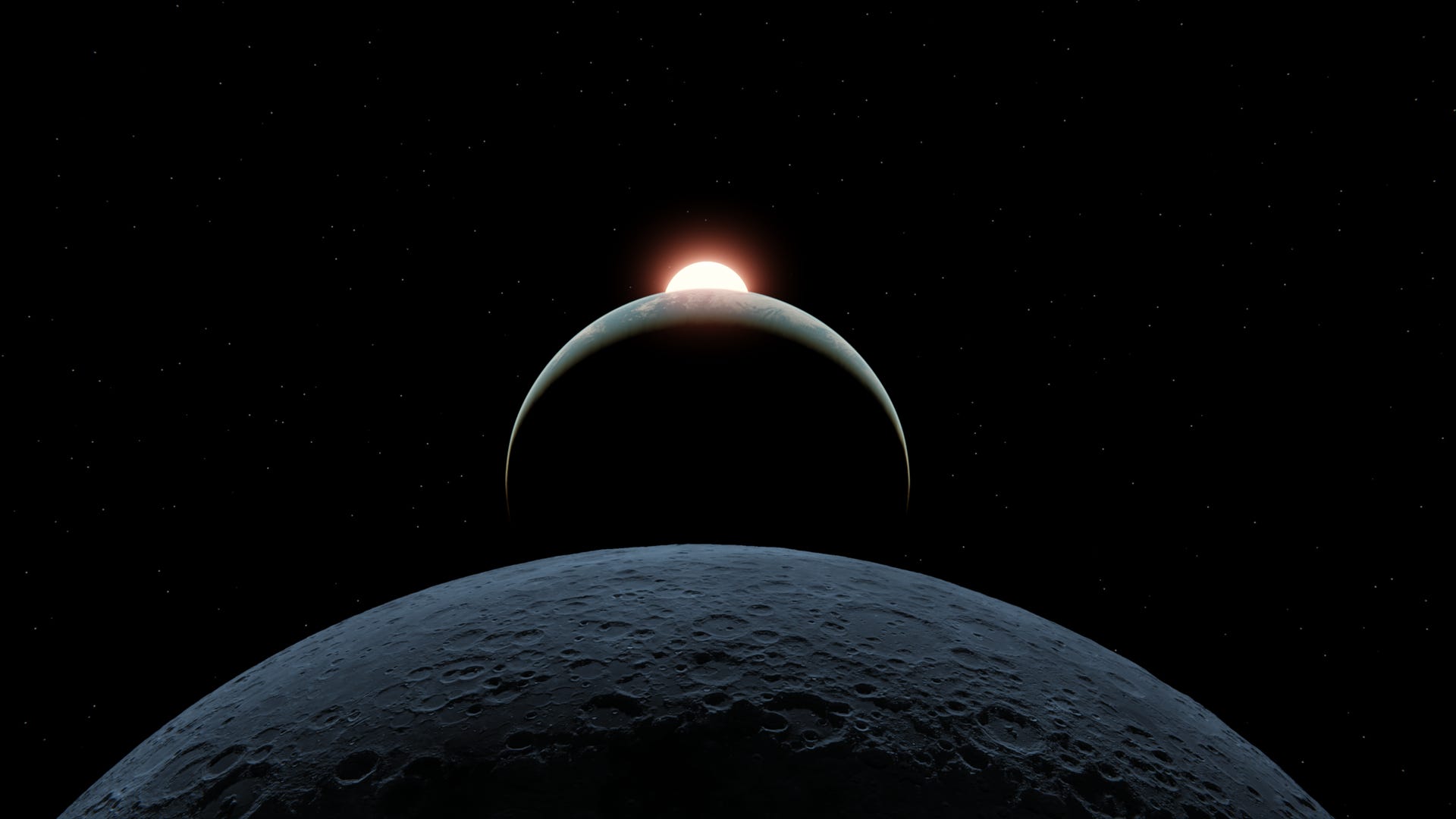
The cuticle crescent of Earth rises from the foregrounded shadowcurve of the moon, to only die into periphery as the magnanimity of the yellow sun glows in tandem tenacity with Richard Strauss’s “Also sprach Zarathustra” (which arguably has become more recognizable than the shot itself). A matrimony and an ordaining priest, a silent syzygy, an alignment of science, reason, and fate. Title sequence over-text: “2001: A Space Odyssey.”
Yep, movies used to be good.
Beyond my glamorization of movies that actually put thought into how they utilize title sequences to prime the audience for their viewing experience, I wanted to unpack the motif of the opening shot.
As we know from countless parodic references and recounts of this movie’s iconic Dawn of Man scene, the apes find a big obelisk floating in their front yard that makes one ape want to smash bones, with that selfsame ape realizing that bones are hidden within other apes, hence Kubrick’s history of the first assault with a deadly weapon.
The music in this scene is unmatched in eeriness, a soprano choral rising to a cliff-edge as ape piles over ape to caress the obelisk’s blank expanse, carefully, ever-slowly, like they might blemish fate itself. Jump cut to their point of view, staring up across the black rectangle face, into the sky, as the droplet-sun peaks over the obsidian edge and presses toward the slivered moon.
By no means of our own, we’ve stumbled upon the ecliptic—the beginning of our sentience toward evolution.
Kubrick moves from bloodlustful apes to a blazoned space station full of oafish humans, careening toward their inevitable meeting with a superintelligent computer with a conscience (?) named HAL 9000. HAL outsmarts the humans. Human (Dave) outmuscles HAL, because, sentience, and all HAL can do is whip up a simulacrum of desperation.
Human has beat technology through his implacable agency and now evolved.
Human (Dave) meets faceless aliens vis-à-vis the obelisk. Aliens introduce human to himself at the omnipresent stages of his life: wizened elder and dying corpse and then, miraculously, a rebirth. A floating fetus watching a waiting cyanotype world, impressed with the potential of the next stage of evolution for the human consciousness, the Übermensch himself as a helpless babe, slipping into an alignment predestined since before 2001.
It’s beautiful.
(It’s absurdly uncomfortable.)
It’s perfect.
My one critique of Kubrick: it’s too clean.
3.
I got back to my apartment after an extended time away, and noticed scattered markers that I had gained a new housemate. He had barreled through the pantry and left little cups of cinnamon and sugar that my roommate had stored away (why?) rolling across the floor.
After scouring around and some deliberation over the daily specials, he decided that the tastiest thing on the shelf was my tub of cocoa powder. He gnawed the lid to pieces with his tiny chompers and had some of the good stuff.
I walked around the place on my toes, like I expected him to walk out of the bathroom in a cloud of mist with a towel around his waist, flipping back his moppy hair between his fop ears as he tells me: that shower drain needs to be unclogged.
The weirdest thing he did was chew and strip an inch off the plastic casing of an extension cord. Little shards of green scattered about. Pellets and droppings and breadcrumbs of nature’s ineffable instinct.
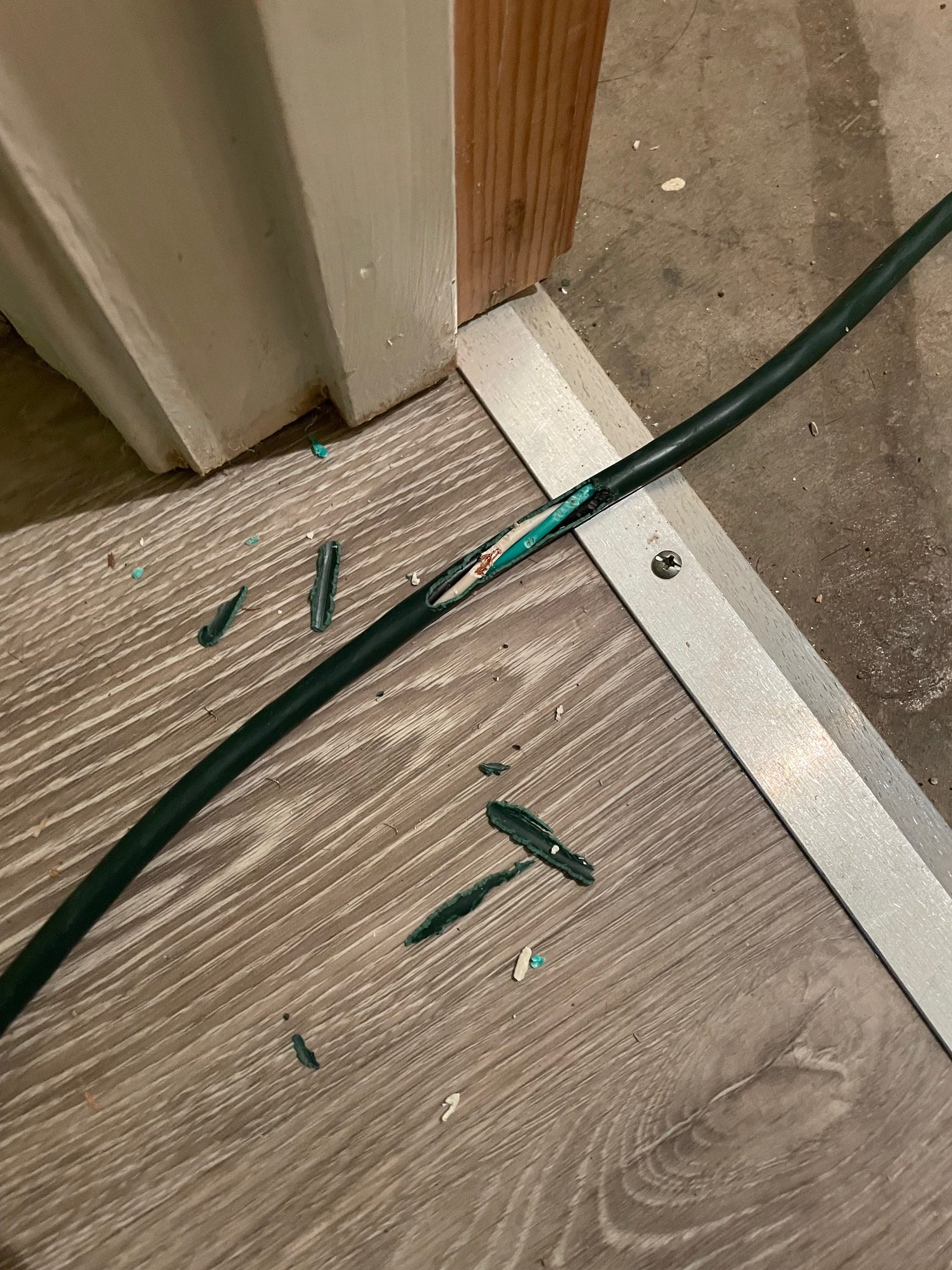
What were you on, buddy?
His mess remains a mystery, as he never made one again. He was clean from that day on. One of my housemates saw his back in a dark hall at 2 am, but that’s as far as we got into our introductions.
For a season, for a place, he lived in our walls, and he reminded me that there’s a certain sanctity to life that isn’t neat. We live, we breathe, we recognize that we’re breathing, we distinguish ourselves from things that don’t breathe, and we leave a mess.
Cultures rise, cultures fall, and the one thing we will always find buried one on top of the other is millennia upon millennia of trash. Existence leaves a mess in our wake.
While humans make a disproportionate amount of the waste compared to the rest of the bleeding world, and account for a disparate amount of willing ignorance to our destructive habits of discarding, all of the small happenings in existence leave something behind.
We were made of mud, right? The Adamah (אדמה), the son of the soil. Our skid marks; our civilizations; our tiny, tender fingerprints on the bedroom walls; our mars and blemishes; our art; they live longer than us. They extend us into the world. We are forgotten by man, but the earth forgets nothing.
We share spaces with other living things, and these traces remind us of our mortality. We will not live forever, but what we leave behind lingers longer. This consideration of the in-between of product and process grounds us in a lived reality, a breath-to-breath hope that we can leave behind something holy and meaningful to the rest of history, even in our byproduct. Our mess has a sacramental value.
4.
Kubrick likes the apes smashing bones. He likes the ten minutes of neon colors and haunting strings in fourth-dimensional space.
He doesn’t like Edison’s 10,000 lightbulb graveyard. Of course, he didn’t have enough film for the full gamut of human progress and the mistakes along the way. That’s okay. We see that enough anyway. This idea of perfect alignment, though, bothers me, and I think Kubrick designed that.
The sun and moon and earth overlap each other, singing to the rest of the universe of their inevitable convergence to the benefit of everything else, the start of a great convalescence from the chaos of yesteryear.
Humanism, the belief that we can achieve and achieve and evolve ad infinitum solely through human reason and consciousness, works as a worldview as long as we focus on the messy middle. Despite it all, we can move forward with preserving human dignity as our basic framework for success. Once we believe in post-humanism, that we can evolve past mistakes, becoming one with the hurtling dynamism of the universe, we lose something. Kubrick points us in the right direction. The central tension of the movie is that HAL’s development was a major oversight, a byproduct of hubris, possibly a mistake.
But the ending frame, with the creepy floating fetus signaling a new dawn of humanity, also builds the absurdity of progress and fate.
Post-humanist progress can be achieved if we stay beyond, harness technology and… wait? Wait for our intellect and souls (props to his metaphysics, I guess) to creep into the night sky along with everything else, to—finally—take a step in the right direction.
Let’s be clear, I don’t buy Kubrick’s cosmology wholesale. I’m not a humanist in the classical sense. I hold (closer) to Mirandola’s ideas of humans as the created center—not the fixed center—of the universe: we can ascend to those “higher beings,” these spiritual virtues, through reason and piety (ascribing to some wisdom higher than ours), or we can descend into an animalistic state through ignoble selfishness, human willpower being the critical pivot between our ascent or descent. We always have a choice.
Psalm 8: 4-5
“[W]hat is man that you are mindful of him,
and the son of man that you care for him?
Yet you have made him a little lower than the heavenly beings.”1
And the in-between of our ascent and descent is messy. Yeah, Kubrick, it’s a lot like shattered bones and corpses of valiant space explorers drifting through aching silence. When I watched this movie, I was struck by one thing above them all.
The breathing.
The Hebrew word for breath is Nephesh (נֶפֶשׁ), meaning, literally, throat, but in Biblical and Hebraic thought is consistently applied to the whole of the person, synonymous with the soul. An individual’s nephesh comprises the entirety of their will and desires. The center-most part of an individual is their Nephesh—both body and spirit—monitored by that omnipresent movement of the diaphragm. The Nephesh grounds you to enumerate choices that determine where one’s whole being goes, up or down, life or death.
Throughout the movie, Dave (our human protagonist) floats from one bone-white space-station anchor to another, his breathing the only sound. He has deep, measured breathing as he moves across the hazy translucence of space to reach a probe; as he dismantles Hal’s memory framework, his breath is shallow and desperate, punching through the waves of the AI’s beseeching: I’m afraid, Dave.
In other words, the breathing grounds him in his humanity. His choice. His breathing reminds him that he has agency in the face of this computer and the indifference of blank space. He’s facing forces far vaster than his limited capacities. His breath is fragile. It’s raspy and shaky and it’s messy.
5.
No, he wasn’t looking for me.
He was trying to make something and left breadcrumbs for me to follow. We are both messy. We are both hidden. We do our best to keep out of each other’s way, but indistinguishably of a singlemind—to make a choice. Go to bed. Stay awake. Find food. Avoid each other.
This choice, the right choice at the right moment, is something like wisdom. Seeing reality and choosing reality rather than growing old in the shadowlands. Sometimes the right choice is glaring, obvious, painful, other times negligibly discernible, amorphous, drowned out by our confidence in progress and personal agency, latent under our loud mouths and sermonizing. It’s never neat.
Kubrick allowed me to sit in uncomfortable silence and consider the messiness of our choices. In these protracted scenes of disorientation and silence that ripped me out of my hyper-distracted, hyper-attention-hungry milieu, I began to feel alive with a choice. Cinema–and good art–fosters a mimetic reality where we can sit in abstraction and ambiguity safely without losing ourselves. I’m not a fan of living a life of perpetual ambiguity and existential dread. But I do like making a choice. I choose truth. I choose life. Breathe in and out.
Ideally, our predominantly noble choices lead us to a fuller humanity that sees the chaos of the world and chooses to love the small things under a Divine ordinance, despite everything else. Our noble choices, our loveliest choices, are still far from perfect. Even the greatest, most life-fulfilling choices we make leave behind a wake. Pay attention to that wake.
Our wake grounds us to the rest of the world. Like a furrow in the dirt, what we leave behind can be where birds drop their waste for a field to become a garden. Getting in the dirt with the rest of the bleeding creatures will not leave us clean.
I’ve been thinking about two ascetics in conversation: Willa Cather’s Ivar from O’Pioneers, and Frederick Buechner’s Godric from his title work. These men are barefoot hermits for two reasons: the pleasure and pain that keep us honest with the unity of existence.
Ivar says,
“The hands, the tongue, the eyes, the heart, all the bodily desires we are commanded to subdue; but the feet are free members. I indulge them without harm to any one, even to trampling filth when my desires are low. They are quickly cleaned again.”2
Compare this with Godric’s penance:
“Jesu [Jesus] walked barefoot up to Calvary, and ever since that day he washed my sins away in Jordan, I’ve gone unshod to honor him.”3
Both men choose to ground themselves with their naked feet, tether themselves to the clay from whence they came with their malformed toes. For we are free to explore just as my mouse friend. Or, scream into the dark. Run along the surface of the land, wishing to float in space, free as our breath. Scrape at the walls and try to find home in exile. Our suffering in this search through chaos reminds us of the One who completed this suffering by living as God and Man, through his mix of blood and water.
And that is beautiful.
I pray that when I leave this earth, my vestiges will speak of playing in the dirt, like a trail of mud prints tracking back to a cracked bedroom door where a little boy tries to hide the secret that he was supposed to be sleeping.
ESV Study Bible. Crossway, 2008
Cather, Willa . O’Pioneers. 1913. pp. 146.
Buechner, Frederick. Godric. 1980. pp. 106.